
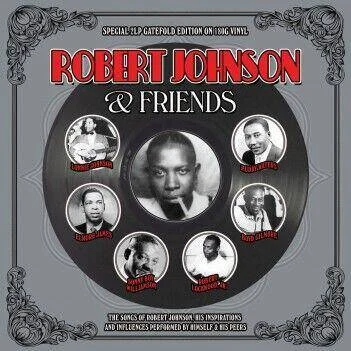
Description
Few bluesmen of any era have proved as influential as Robert Johnson. A scan of the tracklisting here reveals titles familiar to fans of such high-profile contemporary acts as Joe Bonamassa, the Rolling Stones, Fleetwood Mac and Steve Miller. But this collection performed by the man himself and his peers takes us further back into blues history, offering more of the essence of the mysterious figure who some credit as the wellspring of postwar blues.
This is an individual of whom very little photographic evidence exists, and whose story involving a supposed deal with the devil has captured the imagination. His uniquely unsettling brand of blues was described by writer Charles Shaar Murray thus: Going to a Robert Johnson record for relaxation is like drinking six double espressos just before midnight and expecting a good nights sleep.
Robert Johnson was born in Hazlehurst, Mississippi in 1911 and, though much of his formative history is patchy, it would appear followed the typical itinerant life of the country bluesman. He not only covered the traditional southern states but also ventured as far north as Canada, an unusually wide field of operations.
As a young man he played the harmonica but really wanted to be a guitar player. His initial fumbling on the latter instrument impressed nobody but after a spell away from his plantation home. Johnson allegedly returned to the fold with an impressive technique, much to the astonishment of his fellow musicians.
This incident led to the tale that he had sold his soul to the devil at an unidentified crossroads in exchange for exceptional musical gifts. The truth of the situation is probably explained by his natural gift for music, plus an ability to learn exceedingly quickly; contemporaries recount that he was able to reproduce the sounds emanating from a phonograph record after a single hearing.
Whatever the truth, few artists in any field of music could expect to establish a reputation, albeit posthumously, on the strength of just 29 recorded tunes exactly what happened in the case of Johnson. All 29, plus alternate takes, were recorded over seven days in 1936 and 1937 by ARC in the less-than-ideal surroundings of hotels and storerooms in San Antonio and Dallas.
His talent is immediately audible, his voice relatively high but emotionally charged, the guitar both inventive and driving. Whoever his influences were, and there were many, Johnson was clearly his own man. The Johnson legend would be rubber-stamped the year after his second set of recordings when he was poisoned in Greenwood, Mississippi while playing a dance. The devils due? It certainly seemed so to his contemporaries.
A truncated life often guarantees unwarranted legendary status, yet in the case of Robert Johnson there should be no argument. His influence can be heard in so many other performers none more so than Johnny Shines, a Chicago-associated musician who spent time working with him. Shines kicks off our collection with Ramblin.
The blues scene of the Thirties in which Johnson was operating was close-knit. Arkansas-born pianist Roosevelt Sykes was a talent scout for Decca and played with every artist the label recorded in that time. These included Kokomo Arnold who, repaying the favour, played on some of Sykess own sessions as well as on recordings by another pianist we feature, Peetie Wheatstraw.
Old Original Kokomo Blues, the song that gave Arnold his name, took its title from a brand of coffee. It was picked up by Robert Johnson and turned into the better-known Sweet Home Chicago, which might seem a little unfair. But then, Arnold had based his own song on Scrapper Blackwells Kokomo Blues! In fairness, this was an era when phonograph records were in their infancy, and repertoire was still being handed down from generation to generation so if others found greater fame with a song, it was as much a reflection of the growth of recorded music as any underhand dealing.
Kokomo Arnold reappeared alongside fellow Delta bluesman Skip James in the Sixties, giving a new generation the chance to experience his unique brand of blues at first hand. James, a contemporary of Johnson, added further lustre to his legend with some significant recordings on the Herwin and Vanguard labels. A new version of Devil Got My Woman, the 1931 original of which features here, titled his final album the year before his death in 1969.
Elmore James was a disciple of Robert Johnson In both his guitar playing and his repertoire. Both were born in Mississippi a handful of years apart but while Johnson cut his historic sessions in 1936-37, Elmore didnt record until 1951, when he laid down the first of many versions of Dust My Broom with another legend, Sonny Boy Williamson, present on harmonica. He and Sonny Boy had become fast friends, working on each others gigs and travelling throughout Mississippi and Arkansas. Elmore simplified Johnsons slide guitar technique and made the Broom riff his own, while we feature Sonny Boy in his own right tackling Stop Breaking Down.
Robert Johnsons trip to the crossroads did more than inspire a song, it wrote a chapter of blues history. Lend an ear to the man and his associates and celebrate the legend.

Reviews
There are no reviews yet.